Mild winter temperatures last year followed by warm temperatures so far this season has brought wheat vernalization requirements to the forefront for some parts of Texas. Many fruit and nut trees require a certain number of chilling hours to flower. Similarly, winter wheat requires an accumulation of cold temperatures to shift from vegetative to reproductive growth. These mechanisms help ensure wheat does not break dormancy too early in the season, or even in the late fall, which would be disastrous. However, in southern Texas, a lack of adequate vernalization hours may delay or prevent seed head formation. In all Texas crops, but especially for summer crops, we often track “heat units” to predict physiological growth and development. In some ways vernalization is conversely “cold units” for successful transition to reproductive growth.
Vernalization can begin as soon as moisture is imbibed into the seed. This means that even wheat not yet emerged begins accumulating chilling hours. Some believe prolonged warm temperatures before vernalization requirements are met may result in the loss of some chilling hours. In cases where vernalization is interrupted by warm temperatures, sporadic (<10%) heading may occur. In other situations where vernalization requirements are not met, wheat heading may occur due to daylight sensitivity. But it will be greatly delayed and flower during much higher temperatures. Significant yield losses are likely in both situations.
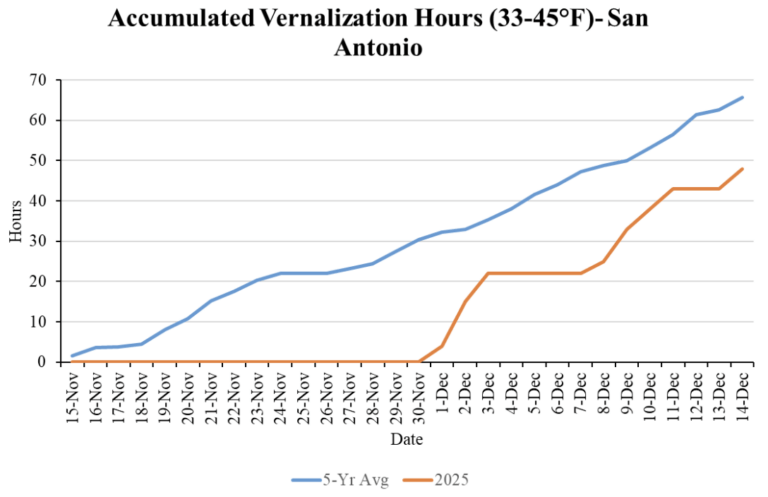
There is a general consensus that vernalization will only occur when the plant is biologically active (temperatures above 32°F) and that requirements vary by variety. However, there is debate about what temperatures are best for this process. Estimates for the upper limits where vernalization accumulation occurs range from 45°F to 50°F. Sources list the optimal temperatures ranging from 35°F-45°F or 40°F-50°F. Texas A&M AgriLife mostly uses temperatures of 33°F-45°F for estimating vernalization hours (see graph). Potential issues will likely appear by early March in the southern half of Texas. Fields with a prolonged period of strongly erect leaves but no observable node pushing above the soil surface will be the first indication of a potential issue.
Though it is still early in the wheat cropping season, warm temperatures have limited vernalization hours so far in 2025. Assuming seed germination on November 15th, there are 17 fewer chill hours in San Antonio compared to the five-year average over the first month of the cropping season. Similar trends are seen in the Southern Blacklands and Central Texas. Management techniques to minimize vernalization issues include selecting adapted varieties and avoiding late planting. Although variety specific vernalization requirements are largely unknown, AgriLife staff can likely provide some guidance based on performance from past regional variety trials. While other cereal crops like winter barley and winter triticale will also require vernalization for seed head development, spring wheat and oats do not have such requirements. Growers south of I-10 in South Texas should consider planting spring wheat to avoid issues.