
With the help of improved infrastructure, what once took nearly a year to complete can now be accomplished in just a few months. For Texas wheat farmers, that kind of progress is more than a scientific milestone; it is a faster path to better genetics. Guided by the needs of Texas wheat farmers, the Texas Wheat Producers Board invests thousands of checkoff dollars each year into research that strengthens the future of wheat production across the state. A substantial portion of that investment supports wheat breeding programs for both Hard Red Winter and Soft Red Winter wheat varieties. These programs are essential to develop genetics that can push higher yield potential, perform better in drier years and maintain resistance when diseases like leaf and stripe rust hit hard.
A New Hub For Wheat Innovation
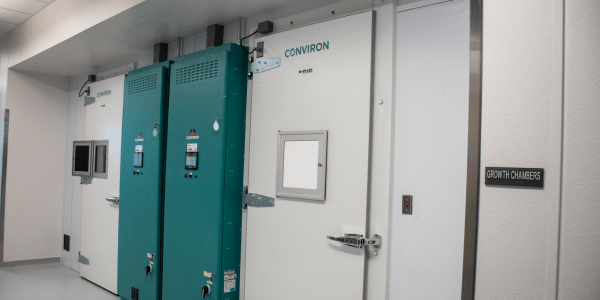
Through its partnership with Texas A&M AgriLife Research, the board helps drive innovation by supporting cutting-edge breeding techniques. One key new opportunity is the opening of the Texas A&M AgriLife High Plains Research and Extension Center in Canyon. The enhanced facility is expected to provide Texas farmers with greater access to research, resources and practical solutions that directly improve their operations. While the building provides much-needed collaborative workspace and state-of-the-art laboratories, one of its most impactful features for the wheat industry lies within two walk-in growth rooms intended to dramatically accelerate the breeding process.
“The wheat breeding process is a long and resource-intensive effort, requiring years of careful selection, testing and validation,” said Jackie Rudd, longtime wheat breeder for the High Plains and Rolling Plains of Texas, “Reducing the breeding cycle time is a transformative step forward for our program. It allows us to respond more quickly to emerging challenges in the field and deliver improved, high-performing varieties to farmers with greater speed and precision.”
Alongside Rudd, Junli Zhang, small grain geneticist and assistant professor in the Texas A&M Department of Soil and Crop Sciences, is helping lead the research efforts within the new facility and its growth rooms.
Measuring roughly 11 feet wide by 18 feet long, each grow room allows researchers to simulate ideal growing conditions year-round, significantly reducing the time required to advance wheat generations. Previously AgriLife researchers were developing varieties in a greenhouse facility, where a single wheat breeding cycle can take up to eight months. The new growth rooms allow researchers to complete a grow season in as little as three to four months, effectively doubling the speed at which new lines can be evaluated and field-tested.
What does that mean for farmers?
It means newer varieties with the latest genetics can be developed and tested in nearly half the time.
Equipped with precise temperature and humidity controls, each room contains prelit wire shelving units, providing capacity for up to 700 wheat plants in one-gallon pots or more than 6,000 plants grown in cones. This level of control and efficiency enables researchers to push breeding timelines faster than ever before, without sacrificing accuracy or data quality.
“We’re excited about the new technology in this facility and the significant gains in breeding efficiency it allows,” said Zhang, “By combining double-haploid lines with speed breeding in the growth rooms, we can advance three to four generations each year, helping us deliver improved varieties to farmers much faster.”
This speed and efficiency allow researchers to respond more quickly to what farmers are seeing in the field, from dry conditions to emerging pests, while helping deliver stronger, higher-yielding varieties. By pairing producer-funded research projects with AgriLife’s commitment to utilizing innovative infrastructure and technologies, the board continues to ensure that wheat breeding in Texas remains forward-looking and farmer-focused.
“It’s exciting to see technology that helps researchers get better varieties in our hands sooner. When you’re dealing with unpredictable weather, disease pressure and tight margins, having improved genetics can make all the difference,” said Jody Bellah, farmer from Throckmorton. “Knowing that our checkoff dollars are being invested in research that will move through this facility is something farmers can be proud of.”