
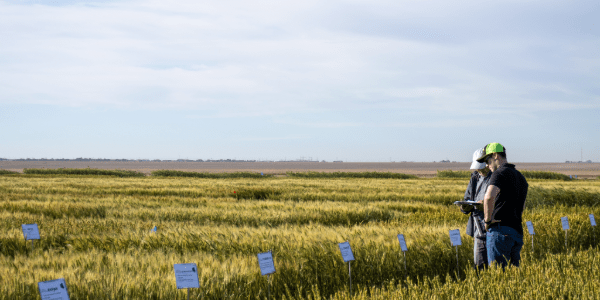
Each year, the Texas Wheat Producers Board supports wheat research and extension efforts throughout the state, including the statewide Uniform Variety Trials. The results of these efforts are most easily seen at local field days where growers can interact with specialists and see variety performance in specific growing regions. This year’s field day season concluded at the Bushland research station and included updates on key pest and management decisions at play for the 2026 crop year.
Read on to learn insights and takeaways from the Potter County Field Day.
Wheat Outlook: Varied Across the State
Dr. Brandon Gerrish, AgriLife Small Grains Specialist, shared an outlook on the wheat crop across the state. In some parts of the state, yields are anticipated below average but still harvestable, but in the Panhandle and much of the Rolling Plains, the outlook is far less certain. Persistent drought, above-average temperatures and a series of compounding stressors are steadily chipping away at crop conditions and left many growers weighing difficult management decisions. Learn more about the wheat outlook in this recent article.
Wheat Streak Mosaic: Later Planting Pays Off
Dr. Nolan Anderson discussed viral disease issues present in this year’s crop with emphasis on Wheat streak mosaic (WSM) and other viral diseases. He reported that fall infections of the virus produced far more severe infections than those that occurred in the spring. To help reduce these fall infections he discussed key management strategies such as later planting dates and controlling the green bridge prior to planting but also mentioned ensuring early planted wheat acres were far away from previously infected fields and host regions. One key note on resistance: even with high vector pressure, resistant varieties took a hit but remained harvestable, primarily as forage.
Insects in Wheat: Know Before You Spray
Extension entomologist Dr. Tyler Gilreath walked through the pest complex showing up in area wheat fields this season. Early in the season, fall armyworm were present, and while brown wheat mites were mentioned, in most cases the populations never reached economic thresholds. Later in the season wheat curl mite, greenbug and bird cherry oat aphids were the bigger concern and, in some cases, warranted applications in some fields. One strong theme from Tyler: monitor beneficials and be selective with insecticide use to manage both costs and unintended impacts.
Wheat as a Feed Commodity: More Value Than You Think
AgriLife Diary Specialist, Dr. Juan Piñeiro gave producers a lot to think about when producing small grain silage. According to survey data, Piñero expects more than 1.5 million tons of small grains silage will be used across the Texas Panhandle dairy industry each year. He maintains that the focus must be on fiber digestibility. Recent research revealed that wheat held its nutritional quality better through key maturity stages when compared to triticale varieties, but both are important silage sources. A key practical finding worth noting: raising your cut height from 3 to 8 inches reduced indigestible fiber by nearly 10% with only a modest numerical yield penalty. This change leaves more residue on the soil to reduce wind erosion, which matters in the Panhandle. If you’re growing small grain silage for a dairy customer, Piñeiro’s advice on pricing: anchor your negotiations to per-unit energy, protein, and fiber digestibility, not just yield.
AgriLife is currently reviewing the results of the Uniform Variety Trials, and Texas Wheat will share the regional summaries via the website and social media, along with including all results in the Texas Wheat Variety Guide. Be on the lookout for the variety guide in the coming months and find trials results below.
2026 Variety Trials