Texas farmers have long helped guide the direction of the wheat industry. As early as the 1940s, producers across the Plains were joining together to tackle drought, quotas, market volatility and a lack of representation in federal farm policy. From those early organizing efforts came a legacy of national leadership, and Texas growers quickly became central figures in navigating some of the most significant farm-policy debates of the past 75 years.
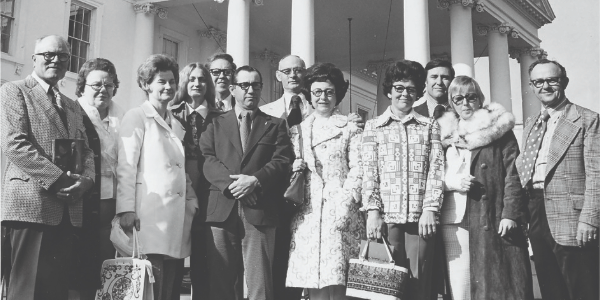
It began with leaders like Ken Kendrick of Stratford, whose influence still echoes today. Kendrick played a pivotal role in forming both the Texas Wheat Producers Association and the Texas Wheat Producers Board, along with helping establish the National Association of Wheat Growers (NAWG). After serving as NAWG president from 1954 to 1956, Kendrick moved to Washington, D.C. in 1963 to serve as the organization’s executive vice president. From Capitol Hill, he guided the national policy agenda during a time when wheat stocks, acreage allotments and export expansion were key issues. Kendrick’s expertise in farm policy earned him a seat on President John F. Kennedy’s Agriculture Advisory Commission. As he neared the end of his career, Kendrick served as president of Great Plains Wheat, which later merged with Western Wheat to form U.S. Wheat Associates.
Another influential Texan, Winston Wilson of Quanah, stepped into national leadership a decade later. As NAWG president in 1979, Wilson helped guide the industry through a period of shifting trade policy and heightened global competition. He served on agriculture policy advisory committees for international trade and export reporting, focusing on export subsidies, price support and strengthening U.S. trade positions worldwide. His leadership earned him an appointment as deputy undersecretary of agriculture at USDA in 1980, where he advised on commodity programs and international affairs. Wilson later led U.S. Wheat Associates as its president and CEO, continuing Texas’ strong influence in the global export market.
Texas leadership continued into the 21st century with Tommy Womack of Tulia, who served as NAWG president in 2003. Womack, and other farmer leaders, emerged as key voices for farm groups lobbying for disaster assistance which helped producers navigate the challenges of weather extremes and economic uncertainty and would lay the foundation for stronger crop insurance provisions in later farm bills.
Womack would later be followed by two more Texans who served as presidents of NAWG, including David Cleavinger of Wildorado in 2008 and Ben Scholz of Lavon in 2019. Scholz still serves on the Texas Wheat Producers Association board today.
Scholz’s presidency coincided with a turbulent period in global trade. He was in Washington when a $14.5 billion aid package was announced to offset losses tied to trade distortions with China under the Market Facilitation Program and returned for the signing of a bilateral trade agreement with Japan and played an active role in advancing the ratification of the USMCA trade agreement. Scholz even addressed producers at a rally on the National Mall, continuing the tradition of Texas representation on the national stage.
For more than seven decades, Texas wheat farmers haven’t just participated in national policy conversations; they’ve led them. From shaping early farm policy debates to navigating today’s global trade challenges, Texas leaders have helped guide the direction of the wheat industry at every major turning point. Their service reflects a deep-rooted belief shared by generations of Texas growers: a collective voice can shape a stronger future for wheat farmers across the country. As the Texas Wheat Producers Association celebrates its 75th anniversary, the legacy of national leadership continues to inspire the next generation of farmers who will shape the future of the wheat industry, both at home and across the world.