
The Whipsaw of Temperatures Curtails Wheat Productivity
This Extension Education Tip is provided by Dr. Calvin Trostle, Texas A&M AgriLife Extension Agronomist, Lubbock, (806) 777-0247, ctrostle@ag.tamu.edu
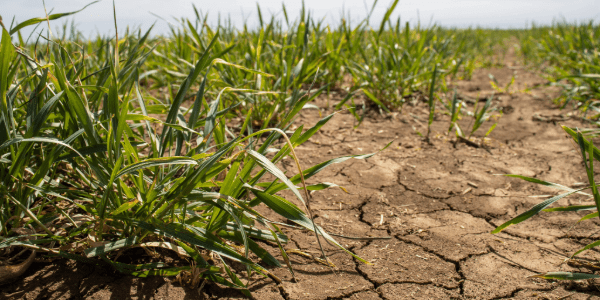
Normally this time of year (March) AgriLife Extension watches the weather forecast for possible spring freezes in relation to stage of wheat growth and development across Texas. Yet here we are in late March 2026 with many days with temperatures of 90 to 100°F. These hot temperatures are never favorable for wheat prior to grain maturity. I remind farmers and colleagues, ‘wheat is a cool-season grass’.
Spring Freezes in Winter Wheat
Wheat freeze injury is a Texas issue about one in every 3–4 years. Often it is limited, but extremes like 2013 (five freezes over six weeks starting late February) wreaked havoc on most of the Texas wheat crop. In general, however, wheat workers have learned that wheat freeze injury is usually never quite as bad as it looks. Grain wheat usually compensates by directing resources to undamaged tillers, etc.
Monday, March 16, saw temperatures in the northern Rolling Plains and the South Plains drop into the 20s (e.g., 24°F around Lubbock) with the Panhandle temps in the teens. I have not heard of or seen any damage to the wheat crop in those areas (most wheat was at late tillering stage, with some at boot stage in the Rolling Plains). In the tillering stage ~24°F for about two hours is the onset of concern. For this March freeze, close inspection might find some growing points (Fig. 1) on larger stems with damage. Otherwise, cosmetic foliar injury is expected with burned leaves. In the Texas Blacklands, wheat was already heading and early varieties possibly flowering when temperatures dropped to ~27°F. Freeze damage on wheat heads has been found as far south as Temple.
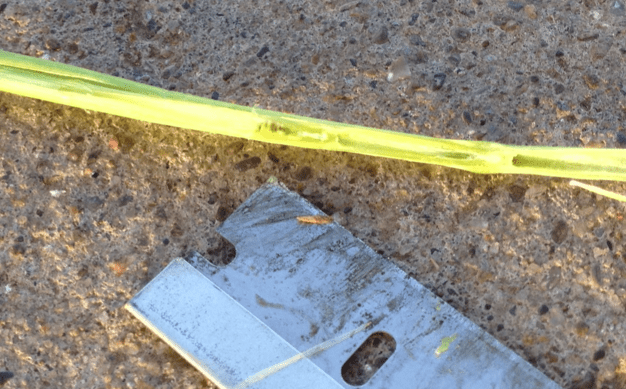
Fig. 1. A split wheat stem (hollow stem on the right) reveals a brown, dead growing point (the tiny head) due to freeze injury. No further head development will occur; this individual stem (not undamaged tillers or the whole plant) will remain in the vegetative stage. (Calvin Trostle).
AgriLife Extension’s “Wheat Freeze Injury in Texas” (ESC-026, 2014) notes flowering stage is the most vulnerable stage of growth at just 32°F (~2 hours) where the pollen is damaged. Floral sterility is often more difficult and takes longer to diagnose than freezes at other growth stages. Growers should continue monitoring for blank heads over the coming weeks. Wheat begins flowering in the middle of the head and moves up and down from there. Growers must feel the entire wheat head to ensure grain fill is occurring throughout. It is possible for the middle to be filling but not the top and bottom or vice-versa, depending on the timing of the freeze.
Multiple resources for assessing and understanding wheat freeze injury in Texas can be found at the link below.
Wheat Freeze Injury ResourcesWinter Wheat in Heat
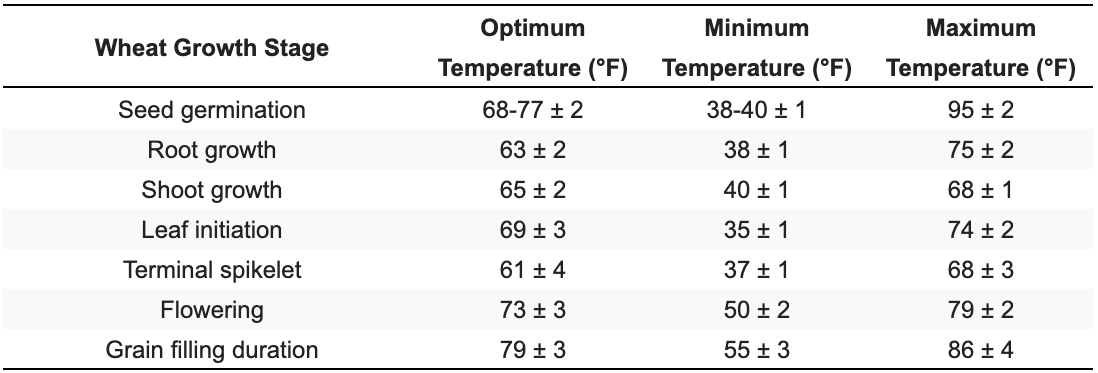
I reiterate, ‘wheat is a cool-season grass.’ When heat units are calculated for estimating wheat growth and development, 86°F is the max temperature. This suggests advantageous growth and development generally ceases at temps above ~86°F. In fact, excessive heat may be detrimental to wheat growth and development. Furthermore, temperatures like much of March in Texas 2026 are draining soil moisture, hence water use efficiency declines. This reduces grain yield.
The following table documents general favorable growing temperatures for wheat. Wheat breeding for high temperature stress tolerance and planting earlier maturing wheat may reduce heat impact. Many genes, including leaf rust and Hessian fly resistance, are temperature sensitive. As temperatures exceed thresholds, plants that normally convey resistance may become susceptible. Possible instances are currently reported in the Blacklands. Conversely, early maturing wheat is somewhat more susceptible to a late freeze.
For further wheat production resources, visit http://varietytesting.tamu.edu/smallgrains.