In May 1949, a group of wheat producers gathered in Amarillo with a bold idea: unite to protect the future of wheat farming in the Texas High Plains. At the center of this effort was Carl Kuper of Dalhart, who proposed that growers formally organize in order to strengthen their voice in state and federal agricultural policy. Kuper and his peers understood the challenges they faced could only be addressed through coordinated action.
Until this time, the group, which was composed of representatives from ten counties in the Texas Panhandle, had been known as the Tri-District Farm Bureau. Upon their formal organization as a commodity association, they changed the name to High Plains Wheat Producers Association. The organization quickly took shape with one elected director and one alternate from each participating county (Dallam, Sherman, Deaf Smith, Carson, Potter, Armstrong, Hartley, Randall and Moore). Their democratic election by fellow producers set a precedent that remains a cornerstone of the association’s identity today.
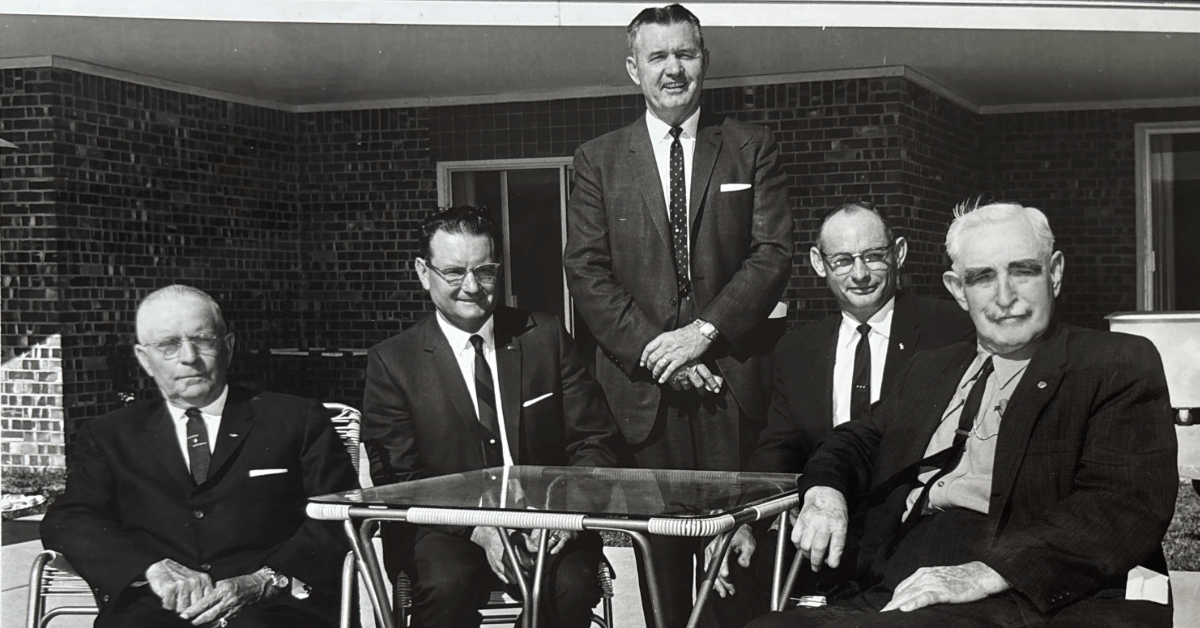
By 1950, the association had formally received its charter from the State of Texas and adopted a new name—Wheat Producers Association of Texas. With its new charter, came the formation of the first executive committee: Ray Converse (Spearman), Lynn Conner (Farnsworth), J.W. “Bill” Cox (Tulia), James Gunter (Claude), Ken Kendrick (Stratford) and Carl Kuper serving as president. Together, these men brought leadership, civic-minded service and a vision for the future of wheat production in Texas. Their stories help illustrate the depth of commitment that built the Texas Wheat Producers Association from the ground up.
Ray Converse
Ray Converse was a dedicated farmer from Spearman, Texas, and a committed member of his community. He was active in the Masons, the Khiva Shriners and the Methodist Church. Though he eventually sold his land and relocated to Amarillo, his legacy remains deeply rooted in Hansford County. To this day, many still refer to parts of his former operation as “the Converse,” a testament to his lasting presence in the area.
Lynn Conner
A longtime resident of Ochiltree County, Lynn Conner moved to Farnsworth in the early 1920s from Oklahoma. In addition to farming and ranching, Conner was deeply involved in local leadership. He served as chairman of the local Agricultural Adjustment Act Unit, president of the Federal Land Bank, president of the Perryton School Board, director at First National Bank and was active in the Khiva Shriners and local bridge club.
Bill Cox
Bill Cox began farming in Swisher County in 1927 after growing up in the Fanchion community. He studied at Texas Tech University and later served as a trustee of Lubbock Christian College. Cox was active in both the Swisher County Farm Bureau and the Farmer’s Union, and served as an elder at Central Church of Christ in Tulia. He and his wife retired to Dumas in 1974 after a lifetime of community involvement.
James Gunter
James Gunter grew up in Claude and was actively involved in FFA, ultimately earning his American degree. He served as a B-24 pilot in World War II before returning to complete his degree at Texas Tech University. After the war, he settled in Claude to farm and ranch and became a leader in the community. His contributions included roles on the Claude School Board, Mid-Plains Rural Telephone Cooperative, Texas Farm Bureau and Southwestern Cattle Raisers Association. He was also a member of the Claude Masonic Lodge, American Legion and Claude First Baptist Church.
Ken Kendrick
Raised on a cotton and wheat farm in Hamlin, Ken Kendrick earned both bachelor’s and master’s degrees from West Texas A&M University. He began his career as a teacher, coach, and later superintendent in Groom before turning to farming in 1946. Kendrick was a passionate advocate for wheat producers, serving as the first secretary of the Wheat Producers Association of Texas and helping found the National Association of Wheat Growers (NAWG), where he also served as secretary/treasurer.
His influence extended nationally where he served on the U.S. Grain Advisory Committee, National Agricultural Advisory Committee, Texas Agricultural Council and Great Plains Wheat Inc. In 1963, Kendrick became NAWG’s Executive Vice President, a position he held until 1968. He later helped establish the Texas Wheat Producers Board, serving as its first chairman from 1971 to 1975. His son, Cagle Kendrick, would go on to follow in his footsteps as a director for both the board and association.
Carl Kuper
Carl Kuper was a farmer, businessman and civic leader. He played a key role in establishing the local electric cooperative (REA), served on the local Texas Farm Bureau board, the Dalhart Board of Education and was active in both the Dalhart and West Texas Chambers of Commerce. He also held leadership positions with the XIT Rodeo and Reunion, the American Heart Association, American Trust Life Insurance Co. and Rural Life Insurance Co., while remaining a dedicated member of Central United Methodist Church.
Kuper was instrumental in introducing irrigation practices that transformed regional farming. In addition to farming, he owned and operated Kuper Grain Corp. and Kuper Oil Co.
The founding members of the Texas Wheat Producers Association were more than just farmers. They were visionaries, organizers and servant leaders who recognized a need in their industry and made personal sacrifices to advance the collective good. Their work laid the foundation for an organization that remains steadfast in its mission more than 75 years later.
Today, TWPA continues to be led by farmers, for farmers, a testament to the enduring legacy of those early pioneers who understood that unity, advocacy and integrity could shape a stronger future for Texas wheat.
Learn more about TWPA’s history, read stories of service and view pictures from the past by visiting the 75th anniversary page. Stay tuned for articles, social content and more throughout the year to celebrate 75 years of advocacy.