
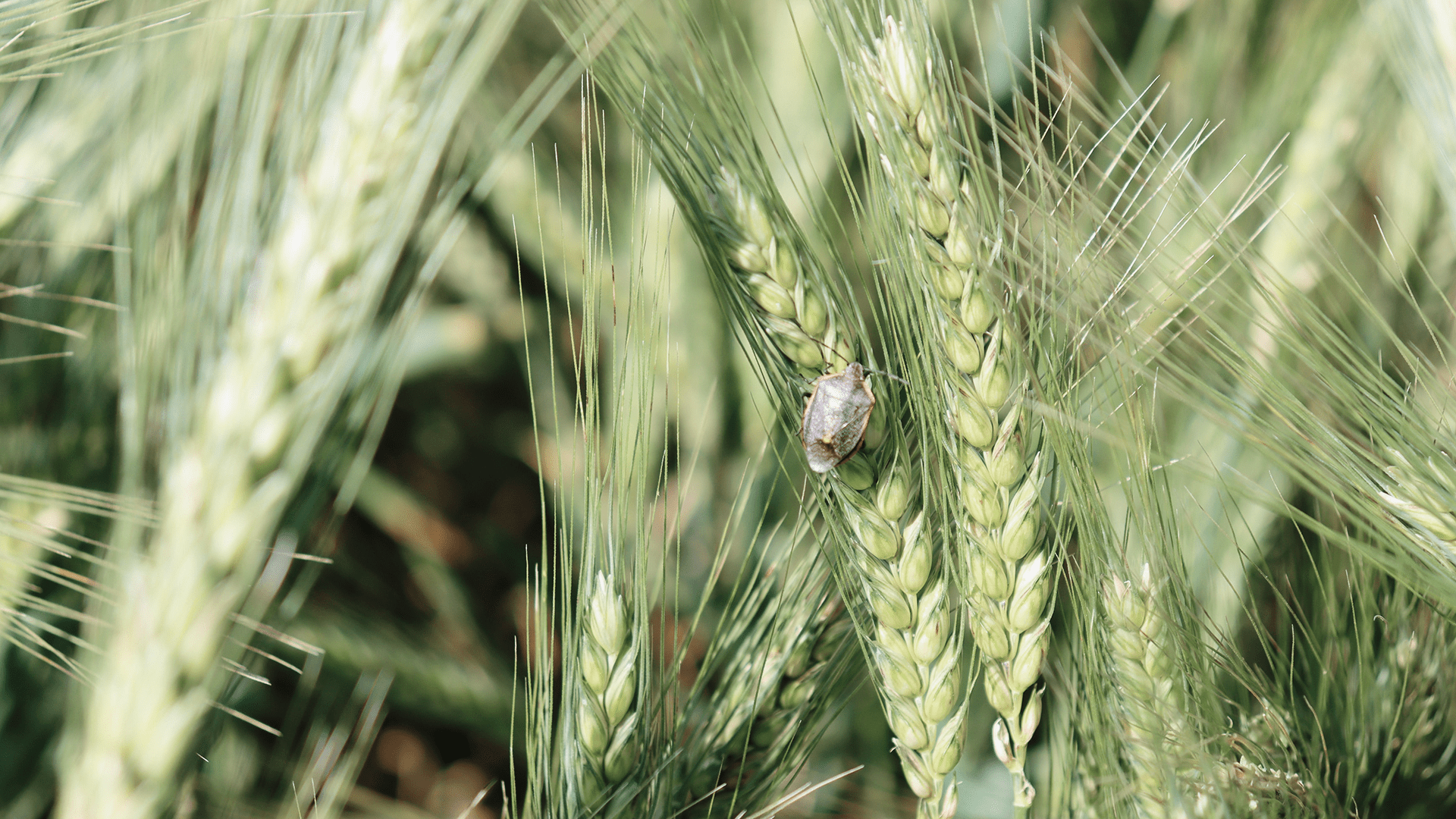
A Grower’s Guide to Scouting and Management
The 2026 wheat crop is progressing across Texas. But growers should be vigilant about insect and mite pests as winter and spring approach.
Aphids
Aphids are the most common insect threat to wheat, especially greenbug (GB), bird cherry-oat aphid (BCOA), English grain aphid, and Russian wheat aphid (RWA). They vary in appearance (Fig. 1), but these small pear-shaped pests can significantly harm wheat crops. Both BCOA and GB are vectors for barley yellow dwarf virus and possibly other viral diseases, which can cause widespread crop damage.
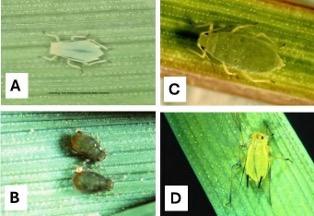
(B), Russian wheat aphids (C), English grain aphid (D). Photo credits: Rick Grantham, Oklahoma State Univ. (A); John Jackman (B); Bart Drees (C), Univ. of Nebraska Extension (D).
RWA poses risks by injecting a toxin during feeding that leads to white and purple streaks along the leaf and causing leaves to curl around their colonies. This leaf curling can shield RWA colonies from non-translaminar insecticides (which do not move within plant tissue), making chemical control less effective. Broad-spectrum insecticides indiscriminately harm beneficial insects that naturally control aphid populations. This may increase the need for additional pest management interventions. Scout plants during the warmest part of the day when aphids are most active. Tapping plants on a white sheet or clipboard makes detection and counting easier.
Mites
Mites are significant arthropod pests capable of transmitting diseases that can cause substantial yield loss. The main species are brown wheat mite, winter grain mite, and wheat curl mite (Fig. 2). Winter grain mites are most active at night and favored by cool, damp weather. Feeding on plants causes browning of leaf tips, stippling, and stunting. Severe infestations give fields a silverish-grey appearance.
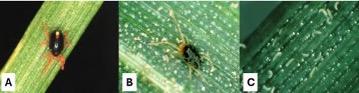
Scout by inspecting plants and soil surface near the crown for winter grain mites. Brown wheat mites have a metallic brown color and are tiny. They are common in the High Plains and Rolling Plains region and are more noticeable during dry conditions. Treatment for brown wheat mites may not be justified if ongoing drought stress can’t be relieved. Brown wheat mites are most active during warm temperatures and plants should be inspected for damage and presence. Wheat curl mite, a microscopic pest, causes leaves to curl, giving an onion leaf appearance. It poses an even larger economic threat by transmitting wheat streak mosaic virus (WSMV). Fields severely infected with WSMV often suffer drastic yield reductions. But if infections are identified early, fields may be heavily grazed maximizing beef production and forgoing a grain crop before planting another summer crop.
Caterpillars
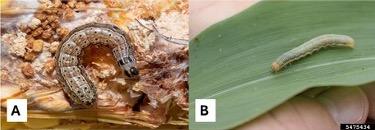
Armyworms, including fall armyworm and true armyworm, are significant pests of small grains (Fig. 3). Fall armyworms attack young wheat in fall and early winter but are not a threat following the first hard freeze. True armyworms prefer mild, damp spring conditions. They hide during the day in the lower canopy or near the plant crown. Scout for true armyworms by checking in the plant canopy and on the soil surface and treat before they damage the flag leaf or start clipping heads to avoid crop loss.
Hessian Fly
The Hessian fly is a significant pest in the eastern half of Texas and the Southern Rolling Plains. It causes stunted wheat, lodging, tiller death, and lower grain yields (Fig. 4). Infestation in the fall and early winter is the most damaging. Currently, no effective retroactive treatments exist, but scouting is recommended. Find Hessian fly by peeling back the leaf sheath to expose the larvae and puparia. Results of Hessian fly scouting operations help with future variety and other management choices and can identify fields that may need to be terminated to plant a spring or summer crop to minimize losses.
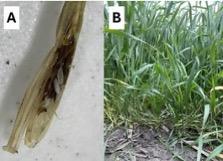
Additional information, including treatment thresholds, on these and other small grain pests is in “Managing Insect and Mite Pests of Texas Small Grains” at https://extensionentomology.tamu.edu/small-grains/.
This Extension Education Tip is provided by Texas A&M AgriLife Extension entomologists:
Tyler Mays, Program Specialist-IPM; Hillsboro (Hill, McLennan, Bell and Falls Counties), (254) 582-4022, tyler.mays@ag.tamu.edu
Dr. Gregory Wilson, Program Specialist-IPM, San Angelo region (Extension District 7), (972) 743-0045, gregory.wilson@ag.tamu.edu
Dr. Tyler Gilreath, Assistant Professor, (972) 989-5933, tyler.gilreath@ag.tamu.edu
Blayne Reed, Program Specialist-IPM, Plainview (Mid Texas High Plains & Upper Rolling Plains), (806) 291-5274, blayne.reed@ag.tamu.edu
This work is supported by the USDA-NIFA Extension Implementation Program, project award no. 2024-7000643508, from the U.S. Department of Agriculture’s National Institute of Food and Agriculture. Any opinions, findings, conclusions, or recommendations expressed in this publication are those of the author(s) and should not be construed to represent any official USDA or U.S. Government determination or policy.
Educational programs of Texas A&M AgriLife Extension Service are open to all citizens without regard to race, color, sex, disability, religion, age or national origin. The information given herein is for educational purposes only. References to commercial products or trade names are made with the understanding that no discrimination is intended and no endorsement by Texas A&M AgriLife Extension Service is implied.