
This Extension Education Tip is provided by Dr. Jourdan Bell, Texas A&M AgriLife Extension Agronomist, Amarillo, (806)-341-8925, jourdan.bell@ag.tamu.edu, and adapted from this original article.
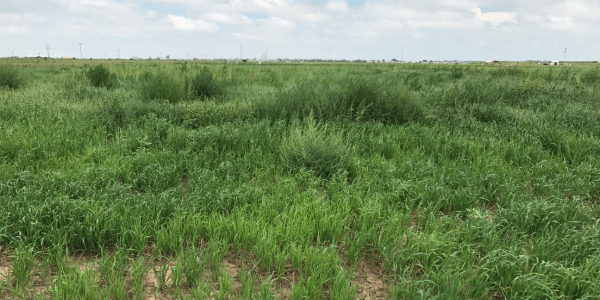
There are many risks associated with volunteer wheat. Volunteer wheat can harbor insects and disease pathogens that can be devastating to your upcoming wheat crop in addition to the crop of your neighbor. While it is often believed that volunteer wheat can be a good source of fall pasture, the negative ramifications associated with volunteer wheat far outweigh any potential benefits. In order to minimize potentially significant yield reductions, it is recommended that the volunteer wheat crop be terminated at least two weeks prior to establishment of the next wheat crop in order to break the “green bridge.” Once the “green bridge” is broken, populations of insects and disease pathogens may not develop in the new wheat crop.
Jump to Burndown and Preplant Herbicide Options.
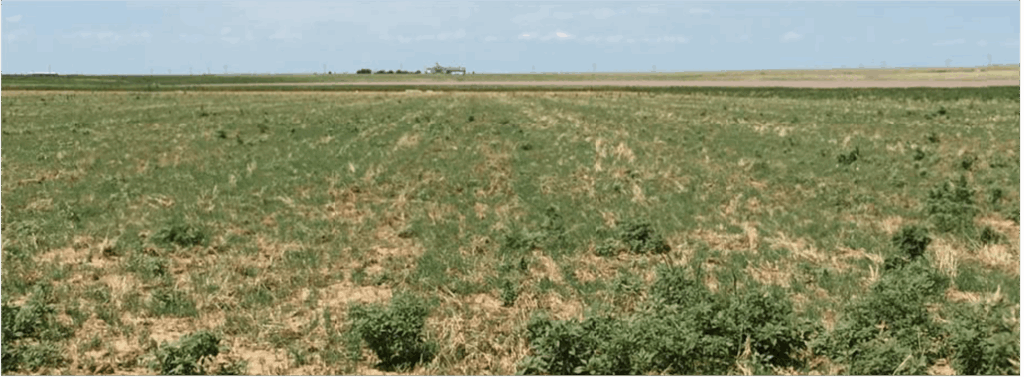
Volunteer wheat and summer weeds during the summer fallow (photo courtesy of Jourdan Bell).
Insects
Volunteer wheat and poor weed control during the fallow period can provide an alternative host for soil pests in wheat such as the white grub, wireworm and army cutworm. Tillage and the use of herbicides are management options to reduce crop residues and control weeds in order to reduce soil pests. While there are not any preplant soil insecticides labeled for wheat fields, insecticide seed treatments can be used to manage some soil pests during the first six weeks after seeding.
Wireworm can be controlled, but there are no seed treatments labeled for white grub control. In the late fall, white grubs move deeper in the soil with receding soil temperature so delaying planting in fields with white grub infestations is an effective method to reduce potential damage. Army cutworms feed on wheat seedlings severing the crown from the plant and ultimately killing young plants. They can potentially feed throughout the fall and into the spring. In order to minimize army cutworm pressure in wheat fields, weeds and crop residues should be properly managed through the use of tillage and/or herbicides.
Volunteer wheat in the Texas High Plains harbors several aphids: Russian wheat aphid, greenbug, the bird cherry oat aphid, and English grain aphid. Greenbugs and Russian wheat aphids inject toxins into the leaf tissue while feeding. In addition to feeding damage, the aphids are vectors of barley yellow dwarf virus (BYDV) and cereal yellow dwarf virus (CYDV), which cause barley yellow dwarf (BYD). By controlling volunteer wheat and delaying the planting until after October 1, there is less time for aphid populations to become established.
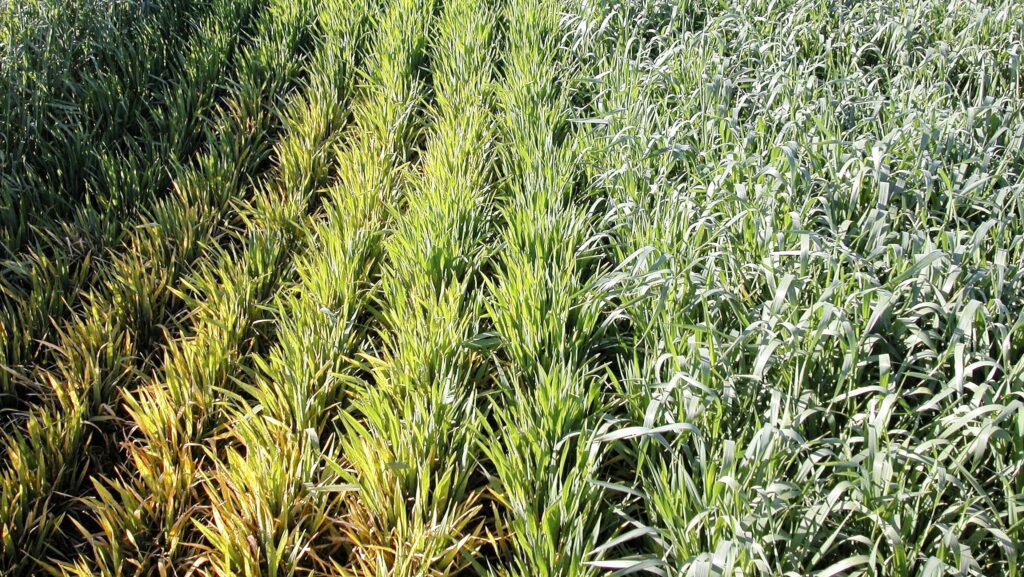
Greenbug damage in wheat (photo courtesy of Pat Porter).
In the southern Rolling Plains, Blacklands and South Texas, another major insect pest of wheat is Hessian fly. Managing residue and volunteer wheat are also important strategies for controlling this pest. While the Hessian fly over summers in the larval stage on wheat residue, destruction of volunteer wheat will deprive first-generation adults of places to deposit their eggs.
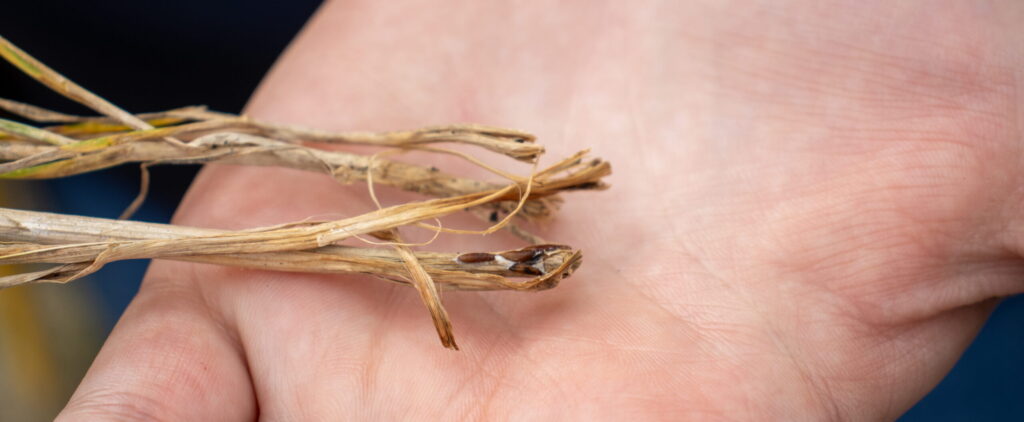
Hessian fly infested wheat.
Diseases
There are three viral pathogens that commonly infect Texas High Plains wheat: wheat streak mosaic virus (WSMV), Triticum mosaic Virus (TriMV), and high plains virus (HPV), which is more properly referred to as wheat mosaic virus (WMoV).
The wheat curl mite is the vector for all three viruses. Unlike the aphids which vector BYDV and CYDV, the wheat curl mite is not an insect; it is a microscopic mite measuring approximately 150 µm. Wheat can be infected with a single virus or a combination of the three viruses. Yield reductions are dependent on the severity of the disease, but the greatest yield losses generally occur in early planted wheat fields. Wheat that is planted early (August and September) for fall grazing is especially susceptible to viral diseases as there has not been adequate time to break the “green bridge” between volunteer wheat that serves as a host for the wheat curl mite/viral diseases and the newly established wheat field.
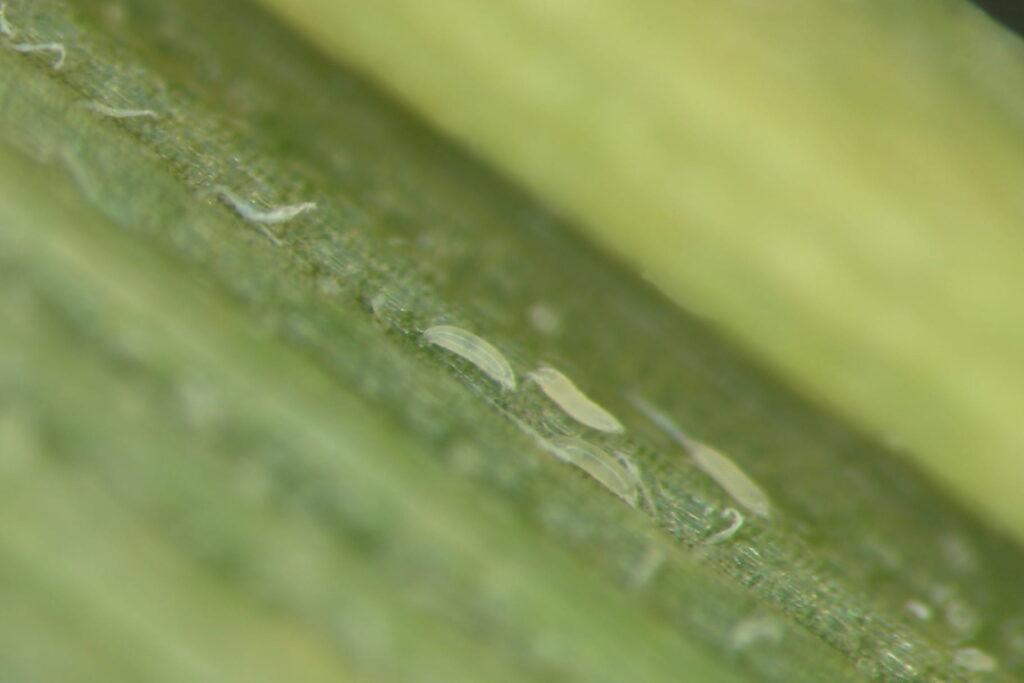
Wheat curl mite (photo courtesy of Nolan Anderson).
Symptoms caused by WSMV, HPV or WMoV, TriMV, BYDV, and CYDV, appear in the spring. Areas of WSMV, HPV or WMoV and TriMV infestation are light green to yellow in comparison to the healthier wheat crop due to the yellow streaking and mottling on the leaf. BYDV infected plants are yellow and stunted, and plants often have underdeveloped root systems.
Further discussion of WSMV and HPV can be accessed here.
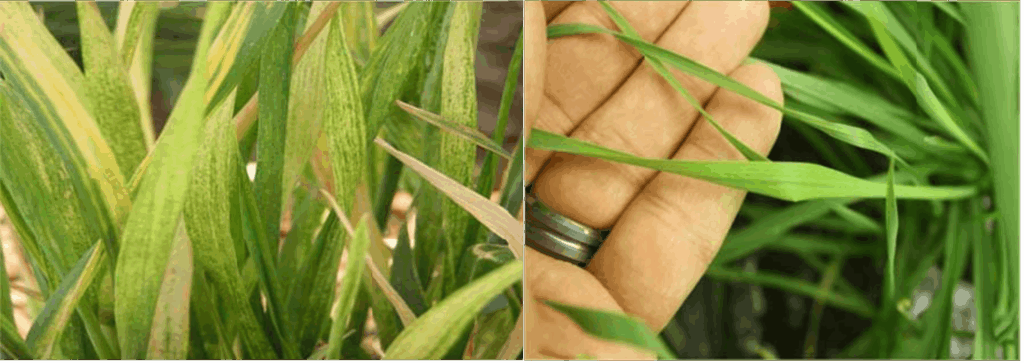
Yellow and mottled leaves from wheat streak mosaic virus (photos courtesy of Jacob A. Price, Charlie M. Rush and Ron. French).
Learn more about wheat streak mosaic from these recent K-State articles:
- Wheat Streak Mosaic Management: Pay Attention to Wheat-Free Windows
- Wheat Streak Mosaic Complex Management: The Role of Other Hosts in the Landscape
- Wheat Streak Mosaic Complex: The Role of Variety Resistance
Volunteer wheat can be controlled by tillage or herbicides. While tillage is often the most cost effective method to control volunteer wheat, tillage is not appropriate on no-till and strip-till acreage. Additionally, tillage prior to planting may result in moisture loss due to evaporation from the seed germination zone that is vital for timely crop establishment especially on dryland acreage. Herbicides provide a good option for controlling volunteer wheat as well as the opportunity to also control fall weeds. Pre-plant burndown herbicides remove initial weed flushes as well as control volunteer wheat. This is a good opportunity to also tank-mix with a pre-plant herbicide with residual activity to extend herbicide control into the cropping season.
Burndown and Preplant Herbicide Options for Volunteer Wheat and Broadleaf Weed Control in a Continuous Wheat System
| Product | Rate per Acre | Remarks |
| Glyphosate Products | Varied | Provides control of many annual and perennial grass and broadleaf weeds. Many formulations are available. Tank mix partners (below) may provide improved broadleaf weed control. |
| +2,4-D | Restrictions | 2,4-D provides some residual broadleaf control, but if incorporating 2,4-D, you must wait 29 days to plant wheat to avoid crop injury. Pay attention to label restrictions. DO NOT apply on emerged wheat in the fall. |
| +Dicamba | Restrictions | Maximum dicamba rate of 8 oz/A per application. There is a planting restriction of 10 days on the label. |
| +Sharpen (saflufenacil) | 1.0-2.0 oz | Do not apply more than 4.0 oz/A and do not apply after emergence. Suggested spray volume of 15 GPA. |
| Gramoxone SL (paraquat) | 2.0– 4.0 pts | In order to achieve complete control of volunteer wheat, the application should be made prior to tillering. Minimum spray volume 10 GPA. |
| Liberty 280 SL (glufosinate) | 22 to 29 fl oz | M70 day plant back restriction for small grains. May be mixed with 2,4-D for improved broadleaf weed control. |
For a comprehensive list of herbicide for wheat, please read ‘Weed Control Recommendations in Wheat.’
Can volunteer wheat be harvested for grain?
Often farmers inquire if volunteer wheat can be harvested for grain. This is not a recommended practice. The majority of cases taking a volunteer wheat crop to harvest will result in lower yields compared to a traditionally planted wheat crop. There are several reasons for this:
- Summer rainfall dictates the germination of the volunteer seed, which often occurs well before the optimal planting window. Early germination and summer growth months creates a greenbridge effect for harboring insects and disease as previously discussed, can significantly impact plant health and yield potential.
- Germination can be non-uniform and distribution of seed is uneven resulting in varying levels of stand densities and crop maturity across a field which complicates harvest timing and increases weed pressure where stands are thin.
- In drier regions of the state and/or in dry years, volunteer wheat that germinates soon after harvest utilizes significant amounts of soil moisture during the summer and fall months reducing the soil moisture reserves necessary for the crop during critical growth stages during the spring.
Under unique environmental scenarios, volunteer wheat crops can be taken to harvest successfully. Conditions that favor a successful crop include
- A dry summer which delays germination until the optimal planting window
- A good crop rotation prior to wheat which limited disease and insect pressure
- A failed wheat crop the previous year which resulted in a high seeding rate and uniform stand
- A wheat variety with good straw strength that can withstand high plant populations or a variety that is resistant to common pests and disease for your area such as greenbug, WSMV, or Hessian fly.