
Quick Links:
- Identifying Hessian Fly
- Management Strategies
- Continuing Research
- Hard Red Winter Wheat Ratings
- Soft Red Winter Wheat Ratings
- What the Research Shows
- What This Means for Farmers
Article adapted from a research paper written by Tyler Mays, Extension Program Specialist-IPM.
Hessian fly is a well-known wheat pest that can cause significant yield losses in severe infestations. In Texas, Hessian fly is commonly seen in the Blacklands, Southern Rolling Plains and South Texas. This pest also has a high level of genetic diversity, with 16 biotypes currently identified, making long-term management difficult.
Infestations were particularly high in the 2026 season, likely due to the mild winter conditions that increased overwintering survival and an increase in volunteer wheat acres. While infestations were widespread and, in some cases, severe, their impact varied considerably from field to field. Some fields experienced moderate damage, while others were nearly decimated.
Identifying Hessian Fly
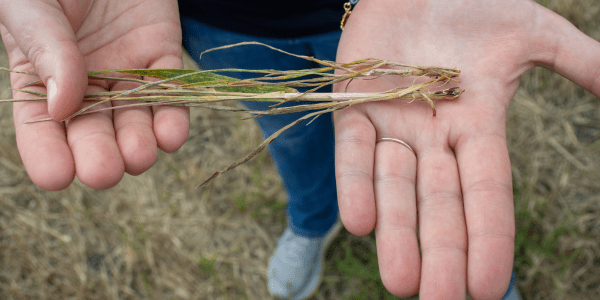
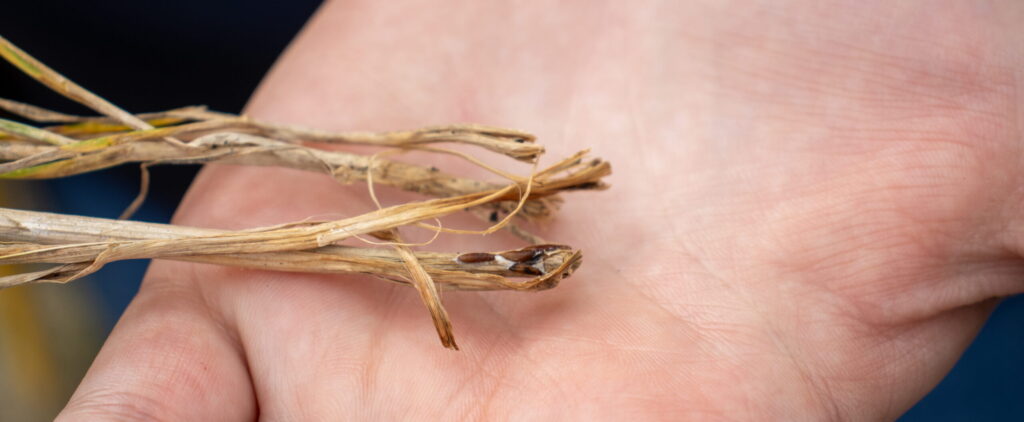
Hessian fly pupae, commonly called flaxseed, can be found throughout the spring on the stem near the leaf nodes, nestled under the leaf sheath. To identify flies in your field, pull the leaf sheath away from the stem at the node and look for small, dark pupae. Stunted tillers, trapped heads, lodged tillers and green tillers can all be indicators of an infestation.
Management Strategies
While wheat may be the preferred host, the pest can also survive on other crops and grasses, including barley, rye, spelt, emmer and wild grasses including quackgrass, western wheat grass and goatgrass. Hessian flies are known to fly up to a mile or more from neighboring fields or other host plants, allowing them to easily spread.
- Management strategies include:
- Planting Hessian fly resistant varieties
- Delaying planting to reduce early-season infestations
- Treating seed with neonicotinoid seed treatment prior to planting
- Burying infested crop residue through tillage
- Controlling volunteer wheat
- Rotating crops rather than planting continuous wheat
Of these options, planting resistant varieties is one of the strongest tools currently available for managing Hessian fly. Resistant cultivars give varieties a genetic advantage that can help plants withstand infestations and reduce significant yield loss.
Continuing Research
Because of the significant impact Hessian fly has on Texas wheat production, the Texas Wheat Producers Board continues to support research aimed at better understanding and managing the pest.
Tyler Mays, Texas A&M AgriLife IPM Extension Program Specialist, has been a leading researcher in this area, producing valuable data to help farmers manage future infestations. Recently, Mays evaluated the response of 30 Hard Red Winter Wheat cultivars and 40 Soft Red Winter Wheat cultivars at five Uniform Variety Trial (UVT) locations in Central Texas: Bell, Ellis, Hillsboro, McLennan and Williamson counties.
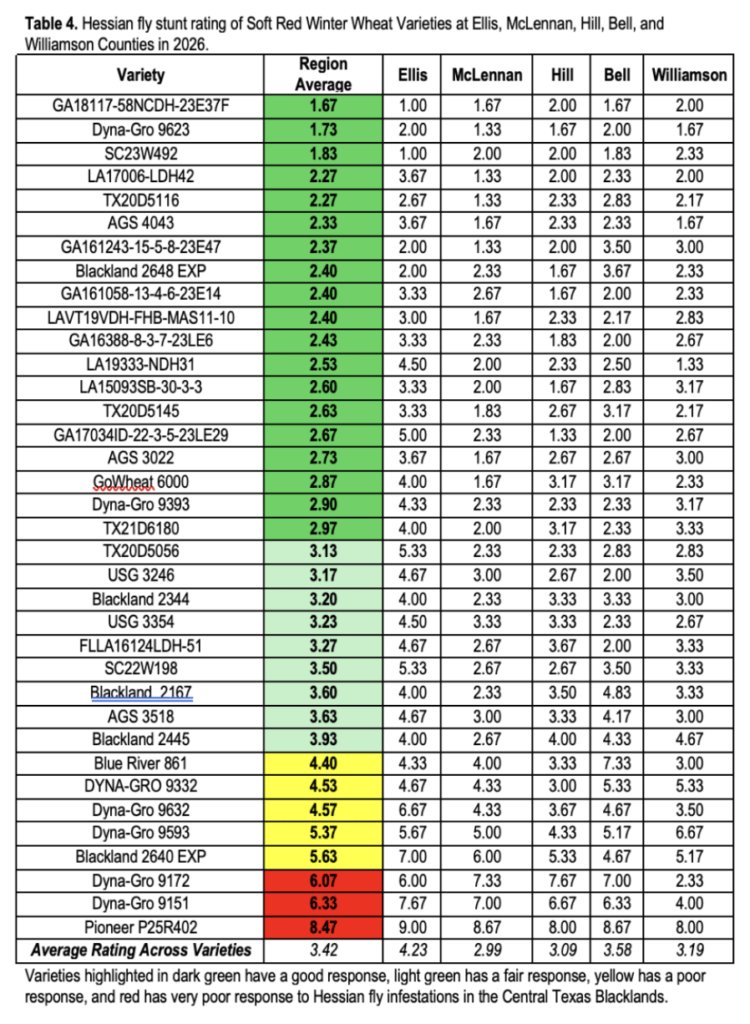
Plots were evaluated after pollination and assigned a 1-9 rating based on the level of plant stunting. A rating of 1 represented a normal plot with no apparent stunting, while a rating of 9 represented a plot in which every plant was severely stunted (Table 1).For this study, a 1-3 response would represent a variety that has good resistance and/or tolerance to Hessian fly, a 4-6 rating represents a tolerant to weak Hessian fly response and a 7-9 rating would represent a variety that should not be planted in areas prone to significant Hessian fly infestations.
Mays cautions that these ratings should not be used as a standalone assessment for variety selection. Other agronomic factors, including poor vernalization, soil compaction and poor stand development, can also contribute to plant stunting. Farmers should consider Hessian fly response alongside yield performance, maturity and other agronomic characteristics when selecting varieties.
Hard Red Winter Wheat Ratings
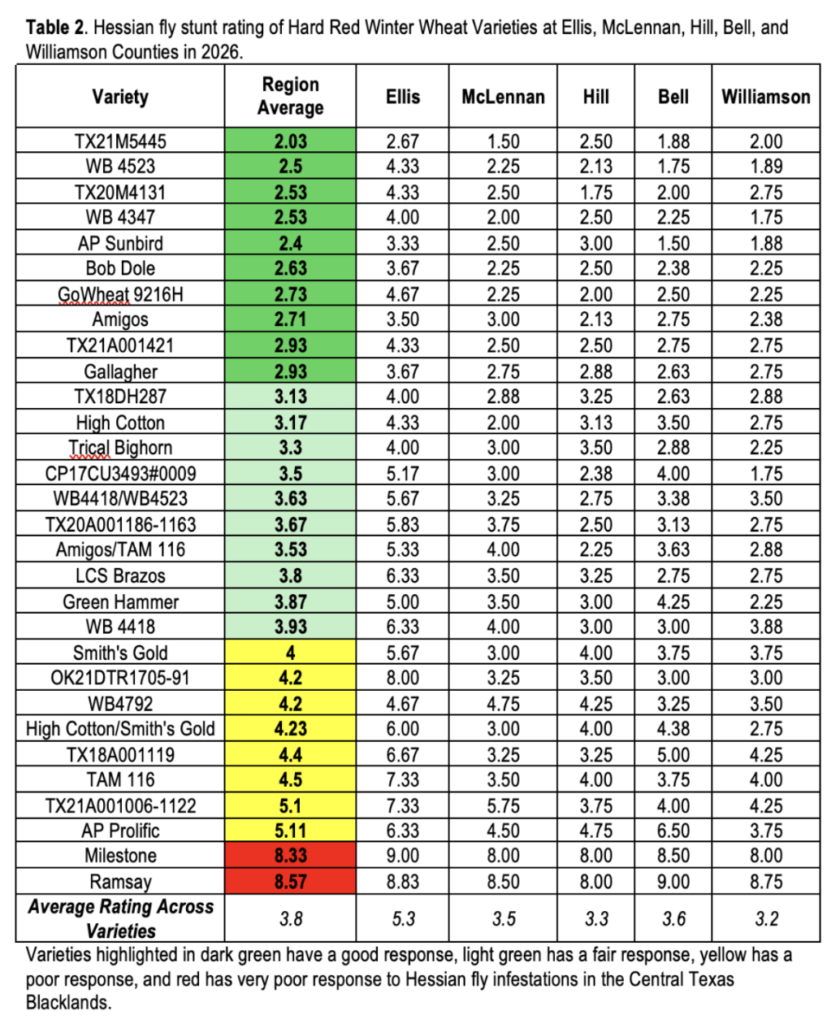
Varieties highlighted in dark green have a good response, light green has a fair response, yellow has a poor response and red has a very poor response to Hessian fly infestations in the Central Texas Blacklands.
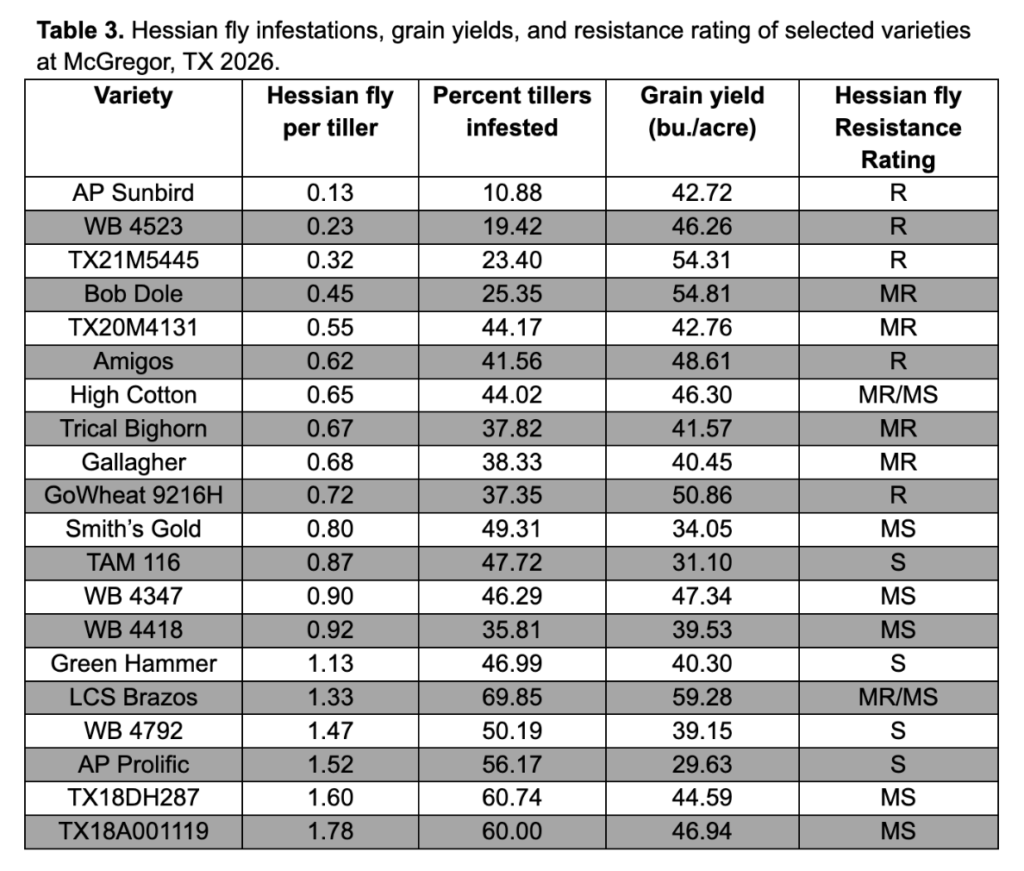
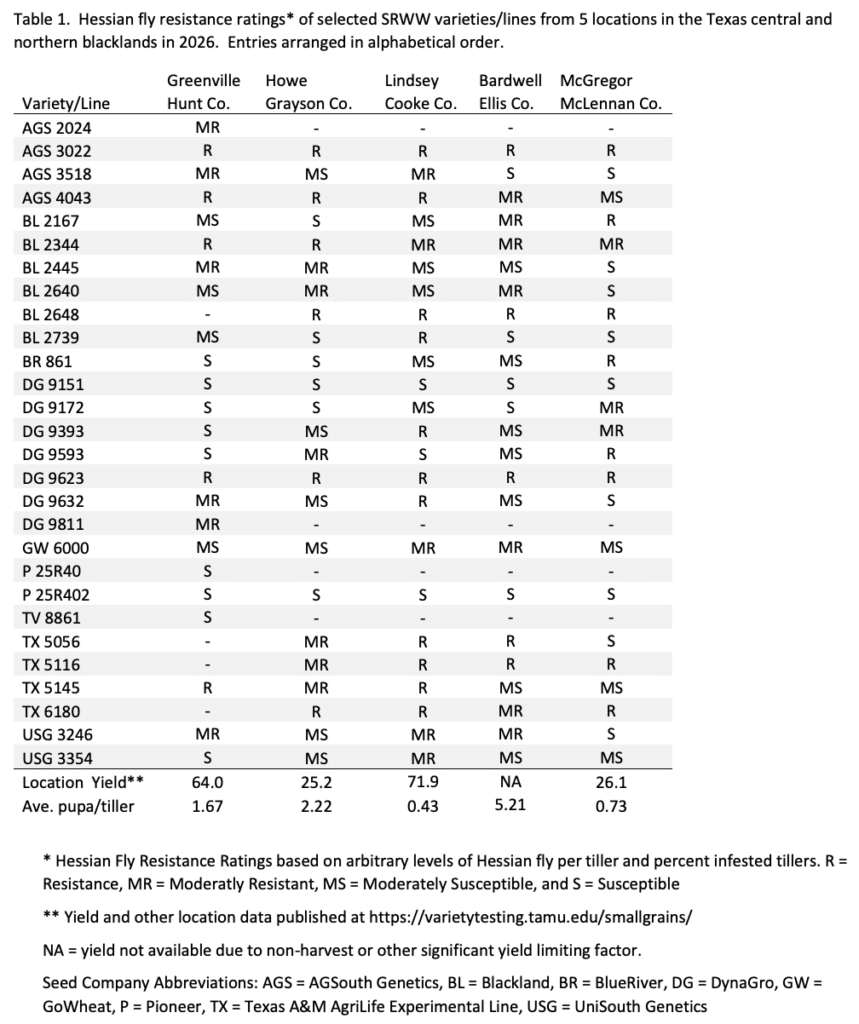
After harvest at the McGregor UVT site, 16 of the 18 commercial varieties and four of the Texas A&M experimental lines were inspected for the number of Hessian fly per tiller and percentage of tillers infested across the first three replications. Researchers dissected 20 randomly selected tillers from each plot. The number of Hessian fly per tiller, percentage of infested tillers and grain yield were used to assign ratings of Resistant (R), Moderately Resistant (MR), Moderately Susceptible (MS) and Susceptible (S) to the cultivars. Initial ratings were based on the number of flies per tiller compared with the trial mean. Grain yield was then considered to help identify varieties that were tolerant to infestations.
Soft Red Winter Wheat Ratings
Varieties highlighted in dark green have a good response, light green has a fair response, yellow has a poor response and red has a very poor response to Hessian fly infestations in the Central Texas Blacklands.
What the Research Shows
Hard Red Winter Wheat
Hessian fly pressure varied significantly among the five locations. Ellis County experienced the highest level of infestation, with an average damage rating of 5.3, while Williamson County had the lowest average rating at 3.2 (Table 2).
Known resistant varieties, including GoWheat 9216H, Gallagher and Amigos, performed well and maintained low regional average ratings. Bob Dole, which is also expected to have some level of tolerance, performed positively across all five locations. Overall, the research identified 10 varieties that appeared to have a high level of tolerance or resistance to Hessian fly and another 10 varieties that showed a tolerant response.
The additional tiller analysis at McGregor (Table 3) identified four commercially available varieties and one experimental line with a resistant response to the native Hessian fly population. The commercial varieties were AP Sunbird, WB4523, Amigos and GoWheat 9216H. High Cotton, a variety previously rated as susceptible, showed moderate resistance at McGregor. However, some commercial fields in the area were heavily impacted by Hessian fly infestations, leaving it with a MR/MS rating in this study. LCS Brazos has also previously been rated as susceptible to Hessian fly. Even so, it was the top-yielding variety in McGregor indicating that LCS Brazos has a good tolerance mechanism against infestations. As a result, it received an MR/MS classification in this study.
Soft Red Winter Wheat
Similar to the HRWW ratings, Hessian fly pressure varied across the locations, with the highest pressure observed in Ellis County, where the SRWW varieties had an average rating of 4.23 (Table 4). Overall, the SRWW varieties had better average ratings than the HRWW varieties, indicating a stronger response to Hessian fly infestations among the SRWW varieties evaluated. Dyna-Gro 9623 performed best across all five locations, while AGS 3022, AGS 4043, GoWheat 6000 and Dyna-Gro 9393 also demonstrated strong responses to fly pressure. Of the 19 commercial SRWW varieties evaluated, six had a good response to Hessian fly, while 5 varieties had a poor response.
What This Means for Farmers
The 2026 Hessian Fly outbreak highlights the importance of considering pest resistance and tolerance when selecting wheat varieties, particularly in areas with a history of Hessian fly pressure.
While no single variety should be selected based solely on Hessian fly response, incorporating Hessian fly ratings with yield data, maturity, disease resistance and other agronomic characteristics can help producers make more informed planting decisions.