
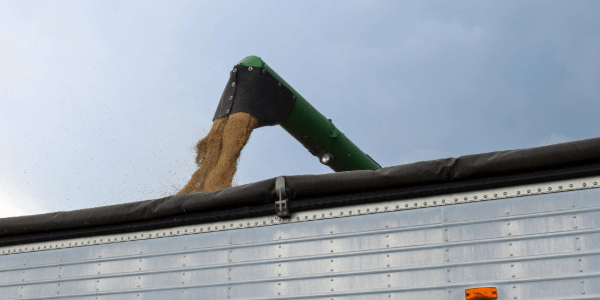
Harvesting and selling wheat just under 13.5% preserves income vs. very dry grain.
This Extension Education Tip is provided by Dr. Calvin Trostle, Texas A&M AgriLife Extension Agronomist, Lubbock, (806) 777-0247, ctrostle@ag.tamu.edu
The standard reference moisture for wheat grain at harvest time is 13.5%. If your wheat moisture is higher than 13.5% you will be docked for moisture. If you are too much above standard moisture content for wheat your delivery point may reject the grain, especially if they do not have drying capacity.
Common incentives that drive harvesting wheat across Texas as soon as possible include:
- Minimizing potential storm and wind damage every day the crop remains in the field.
- Muddy conditions that delay harvest if it rains again.
- Lodging risk.
- Minimizing late-season weed issues.
- Possible double-cropping scenarios where the sooner the next crop is in the more time it has for growth and maturation.
But there is another potential downside to harvesting dry wheat—or any grain—when the crop remains in the field, further drying to well below standard moisture content. Namely, the drier the grain, the more grain it takes to make a 60-lb., or bushel, pay unit. In effect, being able to deliver wheat as close as you can up to 13.5% enables you to “sell water.” Conversely, as noted above, if wheat moisture is >13.5%, you don’t get paid—you get docked.
But how much is the potential income reduction in selling dry wheat? Is it a little? Is it a lot? Could you have harvested sooner at somewhat higher moisture?
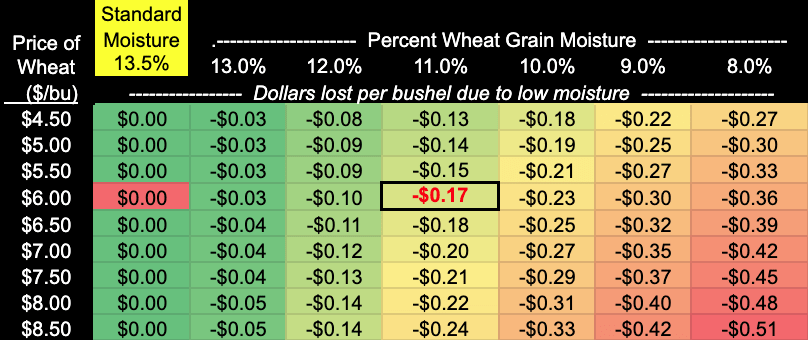
Below is a table for wheat with different moisture contents at a range of wheat prices ($/bushel). This helps you understand the potential reduction in your effective per-bushel wheat price, the more you sell below 13.5%. A link to this interactive table (plug in your values) and a calculator, “Wheat Grain Moisture Calculator—Potential Income Loss” is posted on the Variety Testing website.
You can estimate your potential reduction in effective per-bushel wheat <13.5% moisture from the table. Access the calculator to determine reduction in potential income per bushel with your actual %moisture and market grain price ($/bu). Furthermore, with grain yield (actual or estimated) you can also calculate your potential reduction in income per acre and per field or farm.
Example:
You harvested wheat at 11.0% moisture at $6.00/bu. From the table (or the calculator in the online file) you find that you have effectively reduced your price $0.17/bu. relative to 13.5% moisture. At 50 bu/acre, this is a loss of potential income of up to $8.43 per acre. And if you have 500 acres of wheat, then you could have “sold water” and preserved up to $4,213 of income.
Weather, availability of harvest equipment, etc. will dictate when you can actually harvest wheat. No, you can’t hit 13.5% most of the time. But if by more timely harvest you can sell wheat at 12.0% moisture instead of 10.0% moisture, you preserve income. The difference is enough to factor in your harvest management decisions to put those savings in your pocket.
For further wheat production resources, visit http://varietytesting.tamu.edu/smallgrains