
This Extension Education Tip is provided by Dr. Brandon Gerrish, Texas A&M AgriLife Small Grains Specialist, College Station, (207) 432-1481, brandon.gerrish@ag.tamu.edu.
With small grains planting underway, producers should take into consideration potential differences in seed size which can affect overall seeding populations. About ten years ago, Texas AgriLife shifted from planting variety trials by weight to a seed count basis. The figure below demonstrates why this switch was made.
How Much Can Varying Seed Size Affect Seeding Rate?
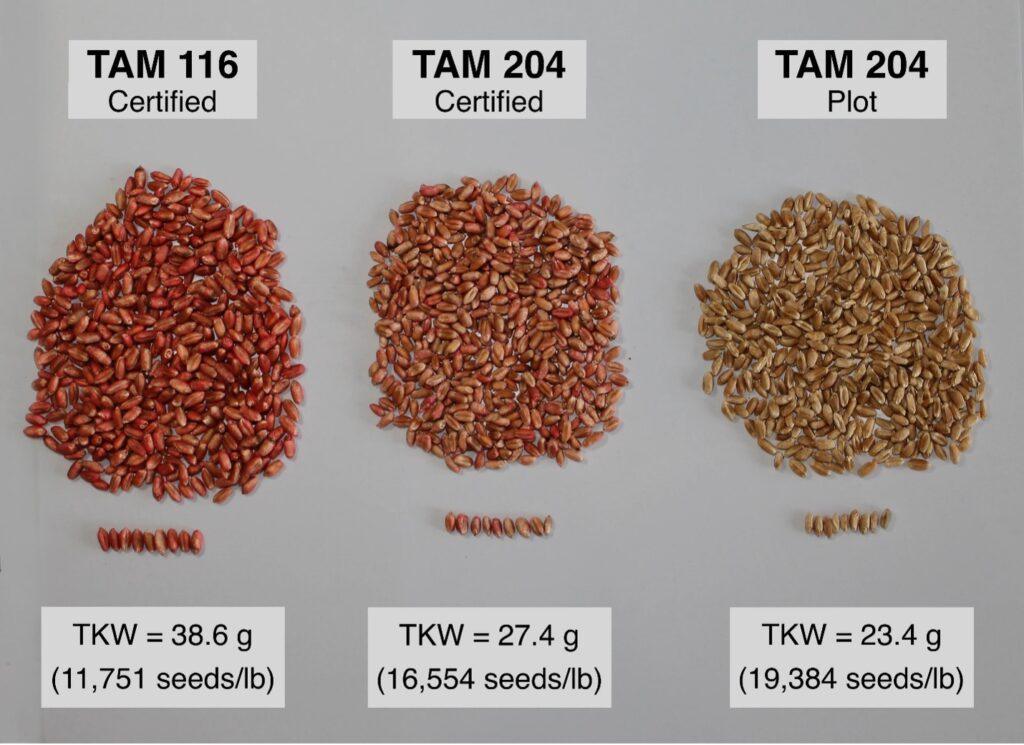
Seed size can be influenced by both genetic and environmental factors. Some varieties (TAM 116) are genetically coded to have a larger kernel than others (TAM 204). However, environmental conditions in which the seed is produced can also have an effect; TAM 204 certified seed grown under irrigation vs TAM 204 plot seed grown in dryland conditions.
Similar to other traits like plant height, genetic and environmental factors will affect seed size. While genetic factors are fixed, environmental conditions will vary. Seed that is produced in a favorable environment, such as under irrigation in the Texas High Plains, will typically have a larger seed size than the same variety grown in dryland conditions under drought. However, these factors often go overlooked during the planting process and can result in planting populations that are much higher or lower than desired.
For example, using the information shown in the figure above and a standard planting rate of 60lbs per acre, the following planting populations can be expected:
- TAM 116 Certified Seed- 11,751 seeds/lb x 60lbs/acre= 705,060 plants per acre
- TAM 204 Certified Seed- 16,554 seeds/lb x 60lbs/acre= 993,240 plants per acre
- TAM 204 Plot Seed- 19,384 seeds/lb x 60lbs/acre= 1,163,040 plants per acre
Planting these two varieties at the same weight per acre basis will lead to a difference of more than 250,000 plants per acre. Moreover, planting the same variety but from different seed sources can lead to differences of more than 150,000 plants per acre. Growers should be aware of these potential differences and how they can affect grain and forage yields.
Potential Disadvantages of Incorrect Seeding Rate
Good stand establishment is often considered the single most important aspect of a high yielding wheat crop. Underplanting a desired rate will lead to lower plant stands which may not be enough to achieve desired yields. If plant stands become too low, incomplete canopy cover may lead to greater weed competition which further decreases yields. Conversely, wheat has a great ability to put on tillers in favorable environments which is diminished if planting rates are too high. Therefore, overplanting will lead to higher seed costs while gaining little yield. These implications will likely also be true for other small grains such as triticale, rye, barley, and oats.