

A solid fertility program is the backbone of a realistic yield goal. However, crop nutrient requirements are only as accurate as the soil samples collected. While a basic, 0-6 inch sample may provide a snapshot of available nutrients, deeper samples are necessary to accurately credit nutrients and optimize your fertilizer investment. As profit margins narrow, it is especially important to assess profile nutrients to more accurately apply fertilizer.
For winter wheat production, shifting from a routine to a strategic sampling plan during the pre-planting season will pay off. To optimize your fertilizer investment, consider the following:
Depth Matters
For many cropping systems, a standard 0-to-6 or 0-to-8 inch core is the default. While surface samples are generally sufficient for phosphorus (P), which is immobile and accumulates near the surface as soil pH and organic matter, they fail to accurately represent residual profile nitrogen. Nitrogen (N) is mobile and moves with the water wetting front. Because wheat has a deep, fibrous root system capable of scavenging nutrients well past the plow layer, a shallow test often underrepresents the true nitrogen bank available in your soil.
In an economic analysis of deep N crediting, Texas A&M AgriLife reported that crediting deep N, if available, has the potential to save a producer more than $40/acre depending on fertilizer prices. For example, finding an extra 30 lbs of residual profile N is a direct credit to your fall or spring fertilizer budget.
Determine Your Sampling Strategy
A single field can contain differences in soil texture, slope, historical management, and yield productivity. For example, if you blend cores from high-yielding zones with cores from an eroded hilltop into one single bucket, you get an average that fits neither zone perfectly.
Depending on your equipment, budget, and field history, refining your sampling strategy and implementing a variable rate fertilizer plan will further optimize your fertilizer investment:
Plan Your Sampling Strategy
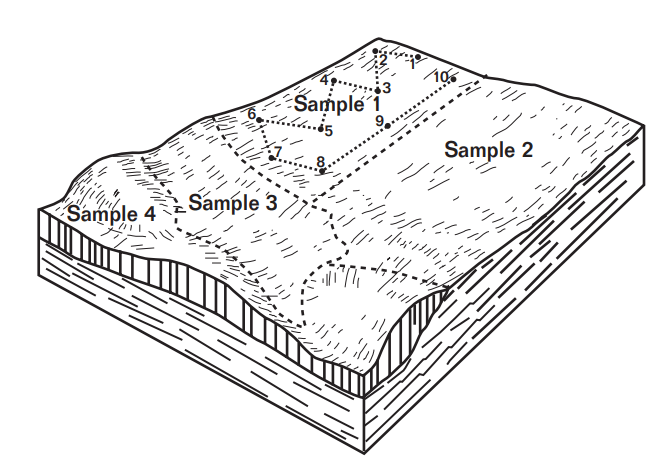
Figure 1. Fields should be subdivided into sampling units based on topography, soil type and historical management as needed. Composite samples should be collected from each unit. From Provin and Pitt, 1999.
| Sampling Strategy | Average Cores Required | Primary
Benefit |
Best
For |
| Grid Sampling | 3+ cores per grid cell | Identifies fertility patterns and historical loading and/or deficits | Fields transitioning to variable-rate technology |
| Management Zone | 10+ cores per zone depending on size | Matches fertility directly to soil type and zone-specific yield potentials | Fields with clear topographical or textural differences |
| Traditional Composite | 15–20 cores per field | Low-cost baseline for overall field averages | Uniform, small acreage fields with consistent history |
Avoid sampling from gullies, slight field depressions, terrace waterways, field edges where equipment turns, or other unusual areas.
Turn Data into Actionable Fertility Plans
Once your soil test returns from the lab, consider your yield goal and nutrient requirements. Although labs provide fertilizer requirements, it is always important to review benchmarks. Apply your P fertilizer in the fall to improve fall tillering and winter hardiness, but consider splitting your N fertilizer requirement between fall and late-winter applications to further optimize your fertilizer investments.
Additional Resources:
Provin, T.L. and J.L. Pitt. 1999. Testing Your Soil: How to Collect and Send Samples, Texas A&M AgriLife Extension, Soil and Crop Sciences E-534. https://soiltesting.tamu.edu/soiltesting/wp-content/uploads/sites/13/2023/05/E-534.pdf
This Extension Education Tip is provided by Dr. Jourdan Bell, Texas A&M AgriLife Extension Agronomist, Amarillo, (806)-341-8925, jourdan.bell@ag.tamu.edu