
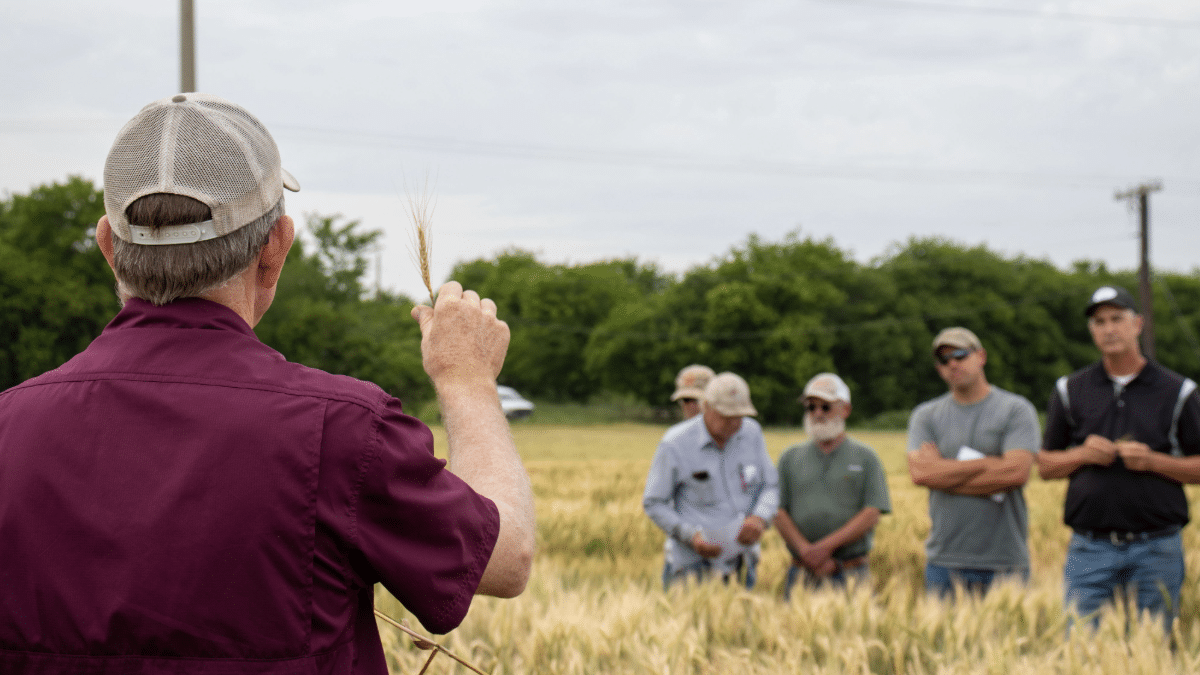
The Texas Wheat Producers Board (TWPB) invests checkoff dollars in research designed to help Texas wheat farmers improve profitability, efficiency and competitiveness. During the 2025-26 fiscal year, more than a third of the board’s annual budget was dedicated to research, contributing to the $3.3 million investment in research over the past ten years. Sixteen projects were funded in the 2025-26 fiscal year, addressing topics ranging from variety development and regional agronomy to silage production and pest resistance. As researchers wrap up their 2025-26 projects, several findings will provide valuable insight for Texas wheat farmers.
Advancements in Wheat Breeding
A significant portion of the board’s research investment supports statewide wheat breeding programs designed to develop varieties that meet the diverse needs of farmers across Texas. Three key breeding programs, located in Canyon, Commerce and College Station, provide regional representation across the state. A new variety from the Canyon breeding program, TX18A001119, is adapted to the High Plains, Central Plains and South Texas, and is expected to be released in 2027. Key varietal advantages of this release include excellent grain performance in irrigated and dryland environments, strong season-long forage yield for dual-purpose and graze-out systems, consistently high test weight, drought tolerance and resistance to leaf rust, stripe rust, stem rust and soil-borne wheat mosaic virus.
In the Blacklands, the breeding program is using new sources of Fusarium Head Blight and Hessian fly resistance from USDA germplasm, making Texas the first Southeastern breeding program to incorporate these traits into new wheat lines. The College Station program has focused on incorporating novel traits, including Biological Nitrification Inhibition, into Texas lines to improve nutrient-use efficiency and potentially reduce input costs for farmers.
Regional Agronomic Efforts
Texas’ diverse growing regions require research tailored to the conditions and challenges farmers face in different parts of the state. Much of the board’s regional research investment supports Statewide Uniform Variety Trials and the evaluation of region-specific management practices, pests and diseases.
The trials provide an unbiased, statewide evaluation of varieties from both university breeding programs and private companies. Recent results highlight the strong performance of varieties released in the last three years. During the 2026 growing season, these varieties demonstrated strong yield potential across multiple regions, accounting for four of the top-yielding varieties in the High Plains Irrigated trials, the third-highest-yielding variety in the Rolling Plains and the highest-yielding variety in the Blacklands. Additionally, Blacklands variety trials evaluated Hessian fly resistance across four locations, providing further insight into varietal performance and supporting informed variety selection decisions (see Evaluating Pest Resistance).
While several of the 2026 trial locations were lost to challenging growing conditions, many were successfully harvested and provided valuable insight into variety performance under stressful conditions. For more information on variety trial results and agronomic recommendations, check out the 2026 Texas Wheat Variety Guide.
Small Grain Silage
The implementation of the Small Grain Silage checkoff has allowed the board to invest more dollars into silage-related research. As regional forage demand and small grain silage acreage has increased, the board recognizes the need for relevant, timely research to help producers make informed decisions for those production systems.
During the 2025-26 funding cycle, the board supported research evaluating three wheat and three triticale varieties at three maturity stages and two cutting heights. Samples are currently being processed and analyzed for nutrient composition and fiber digestibility. Once complete, the results will provide additional insight into how harvest timing and cutting height affect forage yield and quality. The board also approved funding for a silage header to support Texas A&M AgriLife Research’s ongoing work in small grain silage production, strengthening its capacity to conduct this project and future studies.
Evaluating Pest Resistance
Two projects funded during the 2025-26 research cycle focused solely on common wheat pests: Hessian fly and Greenbug.
An estimated 8 percent of Texas wheat acres were infested with Hessian fly in 2026, with the majority of affected acres located in the Blacklands. These severe infestations resulted in an estimated loss of 5.18 million bushels and an economic impact of more than $26 million. While devastating for farmers in the region, the widespread infestation also provided an opportunity to evaluate varietal Hessian fly resistance under severe conditions. Research funded by the board identified the following five varieties as resistant to Hessian fly: AP Sunbird, WB4523, Amigos, GoWheat 9216H and TX21M5445. Additionally, the following five varieties were identified as tolerant: Gallagher, Bob Dole, Trical Bighorn, LCS Brazos and TX20M4131.
A separate project took a molecular approach to Greenbug resistance. Researchers targeted specific RNA molecules and evaluated their effects on Greenbug survival. Three of the four targets reduced Greenbug survival, providing a promising starting point for further research into incorporating these RNA targets into wheat lines.
Farmer-Driven Research
The board remains committed to investing in research that addresses the biggest challenges facing Texas wheat farmers. To help identify those challenges, the board recently asked farmers across the state to share the issues they face on their operations and the questions they believe research should seek to address.
Responses from the survey helped kickstart the development of a research strategic plan outlining key farmer-driven priorities. These priorities will help guide the board’s next call for proposals and funding decisions for the 2027-28 research cycle, ensuring farmer dollars are invested in research that addresses the most pressing challenges facing Texas wheat farmers.